

ListETL
Data fragmentation limits visibility and drains operational efficiency. List ETL bridges this gap as an enterprise-grade data integration platform that extracts, transforms, validates, and loads data across multiple business applications. Rather than functioning solely as an import utility, List ETL powers end-to-end data migration and bidirectional synchronization with robust error handling and auditing capabilities.
List ETL enables organizations to connect virtually any internal or third-party system with native support for:
Direct parsing of Excel (XLS/XLSX), CSV, JSON, XML, structured TXT, multi-file ZIP archives, and live Google Sheets.
Pre-built connectors for platforms like Zoho CRM, Salesforce, HubSpot, Odoo, Mailchimp, and Microsoft Dynamics, alongside custom REST and GraphQL APIs.
Scalable connections to PostgreSQL, MySQL, SQL Server, Oracle, MongoDB, Snowflake, and Google BigQuery.
Secure extraction from AWS S3, Azure Blob, Google Drive, OneDrive, and Dropbox.
Seamless, zero-friction sync across List CRM, List CMS, List Engage, List PBX, and List Drive.
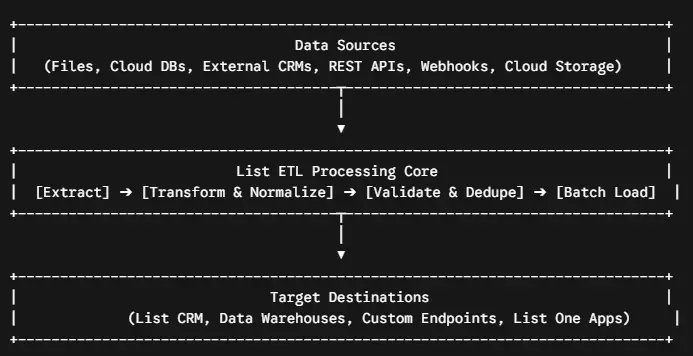
The system standardizes data handling through a structured workflow that guarantees data integrity before commits occur:
Connect via encrypted OAuth2, API Key, or direct file upload with automatic schema detection.
Load destination metadata, including field types, validation constraints, and permission boundaries.
Map attributes dynamically using name-similarity heuristics, manual overrides, and default value definitions.
Normalize phone numbers to international formats (+971), convert date strings to ISO standards, split or merge fields, and map picklists.
Automatically resolve foreign identifiers (such as matching an Owner Email to an internal user_uuid).
Prevent data pollution with deduplication strategies based on email, phone numbers, or custom composite keys (Skip, Update, Merge, or Review Queue).
Verify required fields, data types, and business rules prior to ingestion.
View detailed projections of valid, invalid, duplicate, and skipped records, complete with a downloadable error log.
Ingest high-volume workloads safely in managed batches (500–1,000 records per chunk) without UI thread blocking.
Access granular audit reports and trigger immediate rollbacks using stored state snapshots.
List ETL is built with an enterprise-first security posture:
High-grade encryption for all database connections and API tokens, with secrets masked in audit logs.
Granular permissions governing who can configure connectors, trigger imports, export error logs, or initiate rollbacks.
Automated pre-load evaluation that assigns data health scores based on completeness, uniqueness, and format compliance.
Automated background synchronization using custom cron intervals and webhook triggers to process only updated records.
Real Estate
Quick Links
Install Our App Today
Join our newsletter
We’ll send you updates once per week.
Aqary Investment social profiles


Powered By